Why are staff claims so hard to submit and verify?
Short answer: Because the checks happen after the claim is sent. Staff fill in a form and hunt for receipts; HR then checks receipts, limits and dates by hand and sends claims back. When the claim is checked as it is made, with the receipt attached and the limit shown, it goes through the first time.

Two sides of the same problem
In the companies we meet, multinationals included, we hear the same two complaints about the staff claim process. Staff say claims are hard to submit. HR says claims are hard to verify. Both are right, and it is the same problem seen from each end.
For the employee submitting:
- A form to fill in, sometimes printed and signed, with receipts stapled or scanned.
- No idea how much of the limit is left until HR says the claim is over it.
- Unsure which category a cost belongs to, or which company should pay in a group.
- Weeks of silence, then a message asking for a receipt they no longer have.
For HR and finance verifying:
- Matching every line on the form to a receipt, by hand, often from hard copies.
- Checking limits, grades and deadlines from a policy document or from memory.
- Sending claims back and forth with the employee until the receipt, the amount and the category agree.
- A month of claims checked in a few days before payroll, which is when mistakes get through.
The back and forth is the real cost. Every claim that is sent back is checked twice, waited on twice and paid late.
Write the claims policy down first
Before any form or system, a staff claims policy needs five answers. If you cannot write each in one line, that is where the arguments start.
- Categories. What can be claimed: meals, mileage, toll, parking, medical, client entertainment.
- Limits. How much per category, per grade, per month or per year.
- Deadline. How long after spending someone can still claim, and what happens to a late one.
- Proof. What counts as a receipt, and what to do when there is none.
- Approvals. Who approves, who checks, who pays, and in what order.
Check the claim when it is made, not after
A claim form template or a shared sheet records the policy. It does not apply it, so the checking falls to HR after the claim is sent. The back and forth stops when every rule is checked at the moment the employee makes the claim. In Employee Claims by GAPAI, the claims system we built, that works like this:
- The receipt comes first. The employee photographs it, confirms the shop, the date and the amount, and the photo stays attached to the claim for good.
- The limit shows before submitting. Each person sees what is left in their grade's limit. A claim that goes over is shown to them first, with an option to claim only what remains.
- One receipt, split properly. A petrol station receipt can become two claim lines, and a dinner can be billed across several companies in the group.
- Fixed allowances claim themselves. A fixed monthly parking allowance appears as a ready claim each month, and the employee confirms it with one tap. No receipt needed.
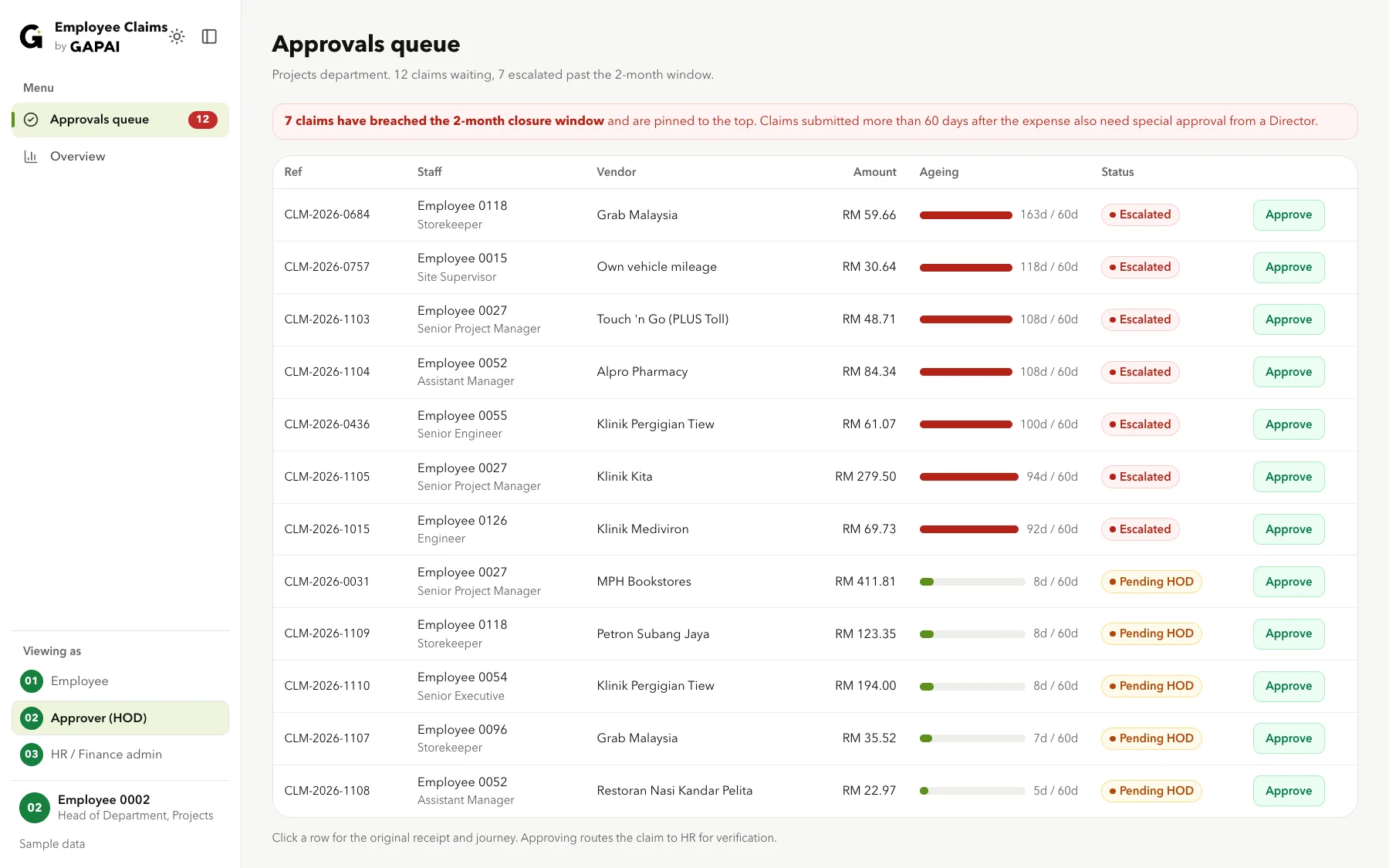
- Age is visible. The head of department sees how long each claim has waited. Claims past the two-month closure window are pinned to the top, and claims made more than 60 days after the spending need a director's approval too.
- Finance gets checked claims. HR verifies, finance processes, and the approved claims go out as one export, filtered by company.
The rules are settings, not code. When management raises the meal limit for a grade, every employee in that grade sees the new limit straight away. We fit the categories, limits and approval chain to how your company already works, so staff submit in a few taps and HR verifies claims that already follow the policy.
Where AI fits
Most of this is plain rules: limits, deadlines and approval order. The one step that suits AI is reading the receipt photo, so the shop, date and amount are filled in for the employee to check rather than typed. A person still confirms every figure before the claim moves. Faded thermal paper and handwritten totals are exactly why that check stays.
Receipts and e-invoices
If your business has started e-invoicing, HASiL asks employees to request the e-invoice in the company's name where they can, and accepts their own-name e-invoice or the usual receipt where they cannot. If you are under the RM3 million threshold, claims carry on with receipts. The rules are in section 7 of HASiL's e-Invoice Specific Guideline v4.9 (PDF).
Where to start this week
- Take last month's claims and count how many were sent back, and why: missing receipt, over the limit, wrong company, late.
- Write your policy's five answers on one page, even if today they live in someone's head.
- Pick the most common reason a claim comes back. That is the first rule worth checking at the moment the claim is made.
Filed under Any business, Manufacturing, Trading and distribution.
Questions people also ask
What should a staff claim process look like?
Five steps: the employee submits the claim with the receipt attached, the limit is checked before it is sent, the head of department approves, HR verifies, and finance pays. Every check that happens at the first step saves a round of back and forth later.
Is a staff claim form template enough?
A template records the policy but does not apply it. Someone still has to check the receipt, the limit and the deadline by hand, which is where the chasing comes from.
What is a fair deadline for submitting claims?
Pick one and apply it the same way for everyone. In the claims system we built, claims open past two months are escalated, and claims made more than 60 days after the spending need a director's approval.
Should approved claims be paid with salary?
Many firms do, and it works when finance receives one checked list of approved claims each month, by company, instead of a pile of forms.
Do staff claims need an e-invoice?
Not while your business is exempt from e-invoicing. Once it is in, HASiL accepts an e-invoice in the employee's name or the usual receipt where one in the company's name is not possible, as long as the employee was spending on the company's behalf.